
LoopStructural#
Overview#
LoopStructural is an open source 3D modelling library providing access to multiple interpolation schemes with a high level and easy to use API for creating geological models. The library has been written for the Loop platform by Lachlan Grose at Monash University.
Loop is an open source 3D probabilistic geological and geophysical modelling platform, initiated by Geoscience Australia and the OneGeology consortium. The project is funded by Australian territory, State and Federal Geological Surveys, the Australian Research Council and the MinEx Collaborative Research Centre.
Examples#
LoopStructural can be used to build a 3D geological model using geological relationships between geological objects e.g. faults, folds, unconformities and stratigraphic contacts. The library also provides a high level API to access the fast interpolation schemes that are used by LoopStructural.
Using GeologicalModel#
The following example shows how to use the geological model interface to create a geological model from a dataset and evaluate the scalar field and gradient of the interpolator at some random locations.
from LoopStructural import GeologicalModel
from LoopStructural.datatypes import BoundingBox
from LoopStructural.visualisation import Loop3DView
from LoopStructural.datasets import load_claudius

import numpy as np
data, bb = load_claudius()

#bb constaints origin and maximum of axis aligned bounding box
#data is a pandas dataframe with X,Y,Z,val,nx,ny,nz, feature_name

model = GeologicalModel(bb[0,:],bb[1,:])
model.data = data
# nelements specifies the number of discrete interpolation elements
# 'stratí' is the feature name in the data dataframe
model.create_and_add_foliation('strati',nelements=1e5)
model.update()
# get the value of the interpolator at some random locations
locations = np.array(
    [
        np.random.uniform(bb[0, 0], bb[1, 0],5),
        np.random.uniform(bb[0, 1], bb[1, 1],5),
        np.random.uniform(bb[0, 2], bb[1, 2],5),
    ]
).T
val = model.evaluate_feature_value('strati', locations)
# get the gradient of the interpolator
gradient = model.evaluate_feature_gradient('strati',locations)

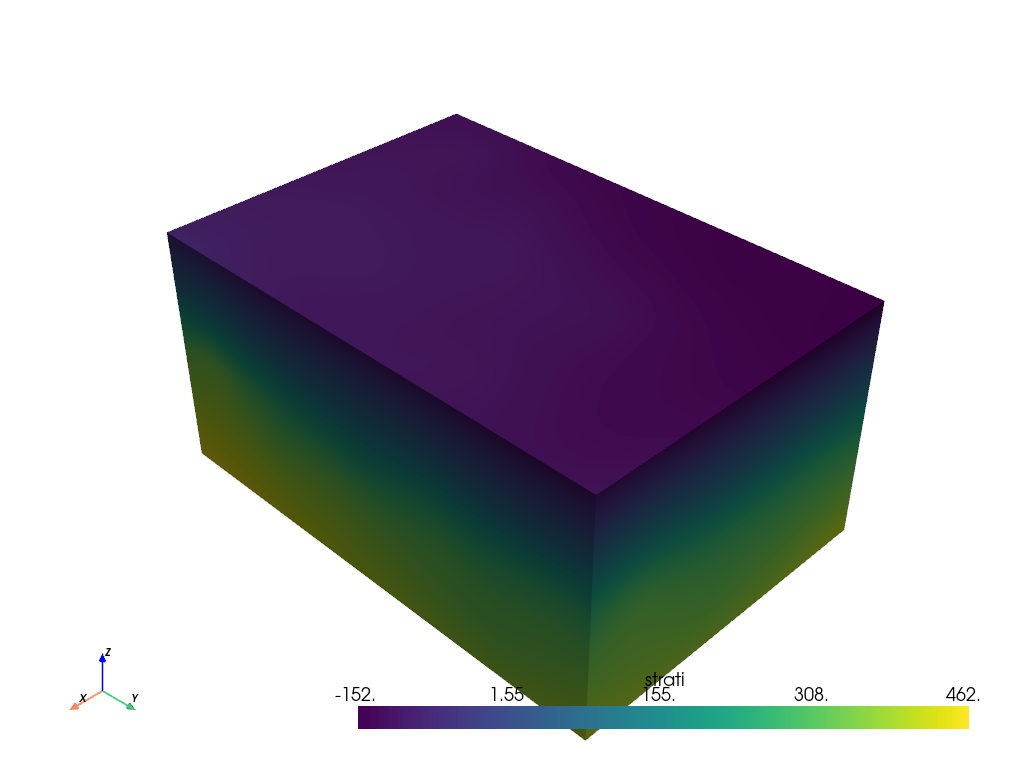
#Plot the scalar field of the model
model['strati'].scalar_field().plot()
Using InterpolatorBuilder#
To access the interpolators directly the InterpolatorBuilder can be used to help assemble an interpolator from a combination of value, gradient and inequality constraints.